
Introduction
Most Indian households know hard water leaves marks on glassware and makes soap harder to lather. Fewer realise it’s doing the same thing, continuously, inside every cistern, sink, and tap fitting — just less visibly, and more expensively.
Hard water damage doesn’t announce itself. It builds up over months and years, until a cistern won’t flush, a tap seizes, or a kitchen sink develops staining no scrubbing removes. By the time damage is obvious, mineral buildup has often already shortened the fitting’s working life by years.
This guide from P4 India covers what hard water actually does to your kitchen sink, cistern, and bathroom fittings, the warning signs to watch for, and what genuinely protects against it.
What Makes Water “Hard” in the First Place?
Hard water carries a high concentration of dissolved minerals — mainly calcium and magnesium carbonates, picked up as water passes through soil and rock before reaching your home. India has extensive hard-water regions, particularly across the north and west, where groundwater and borewell sources run through limestone-rich strata.
The water itself isn’t unsafe. The problem is what happens when it sits, heats, or evaporates on a surface: the dissolved minerals crystallise into limescale, a chalky, stubborn buildup that clings to whatever it touches — including sanitaryware, cisterns, and every CP fitting in your bathroom.
How Hard Water Damages Your Kitchen Sink
Staining. Mineral deposits bond to stainless steel’s texture, creating a cloudy, spotted film that traps further buildup and can contribute to pitting corrosion in lower-grade steel. This is one of the most common complaints
behind “hard water stains kitchen sink” searches, and it’s largely preventable with the right grade of steel.
Faucet clogging. Limescale accumulates inside aerators and spray heads, restricting flow and causing weak, uneven streams — a degradation most people blame on “the tap getting old” rather than mineral buildup.
Drain scaling. Deposits gradually narrow drain pipes and P-traps beneath the sink, slowing drainage and creating a rougher surface where grease and food particles adhere more easily.
Shorter fixture life. Chrome-plated fixtures under constant scaling lose their finish faster, developing a dull, etched look polishing can’t fully reverse. A well-built Kitchen Sink, paired with quality CP fittings, resists this far longer than budget alternatives.
How Hard Water Damages Your Cistern
The cistern is one of the most overlooked casualties of hard water, hidden behind porcelain sanitaryware and rarely opened for inspection.
Valve scaling. Limescale builds up on the flush valve seal and inlet float valve, the components responsible for a clean, complete flush. As scale accumulates, seals stop forming a tight fit — causing the slow, continuous trickle many households mistake for normal cistern noise, but which actually signals cistern scaling.
Reduced flush efficiency. A partially scaled flush mechanism releases less water with less force, so waste isn’t cleared on the first flush — a problem many “solve” by flushing twice, unaware the real fix is descaling or replacing the valve.
Fill mechanism failure. The float valve controlling water level is especially vulnerable to scale, since it sits in near-constant contact with standing water. A scaled valve can stick open or closed, causing constant overflow or a cistern that never fills.
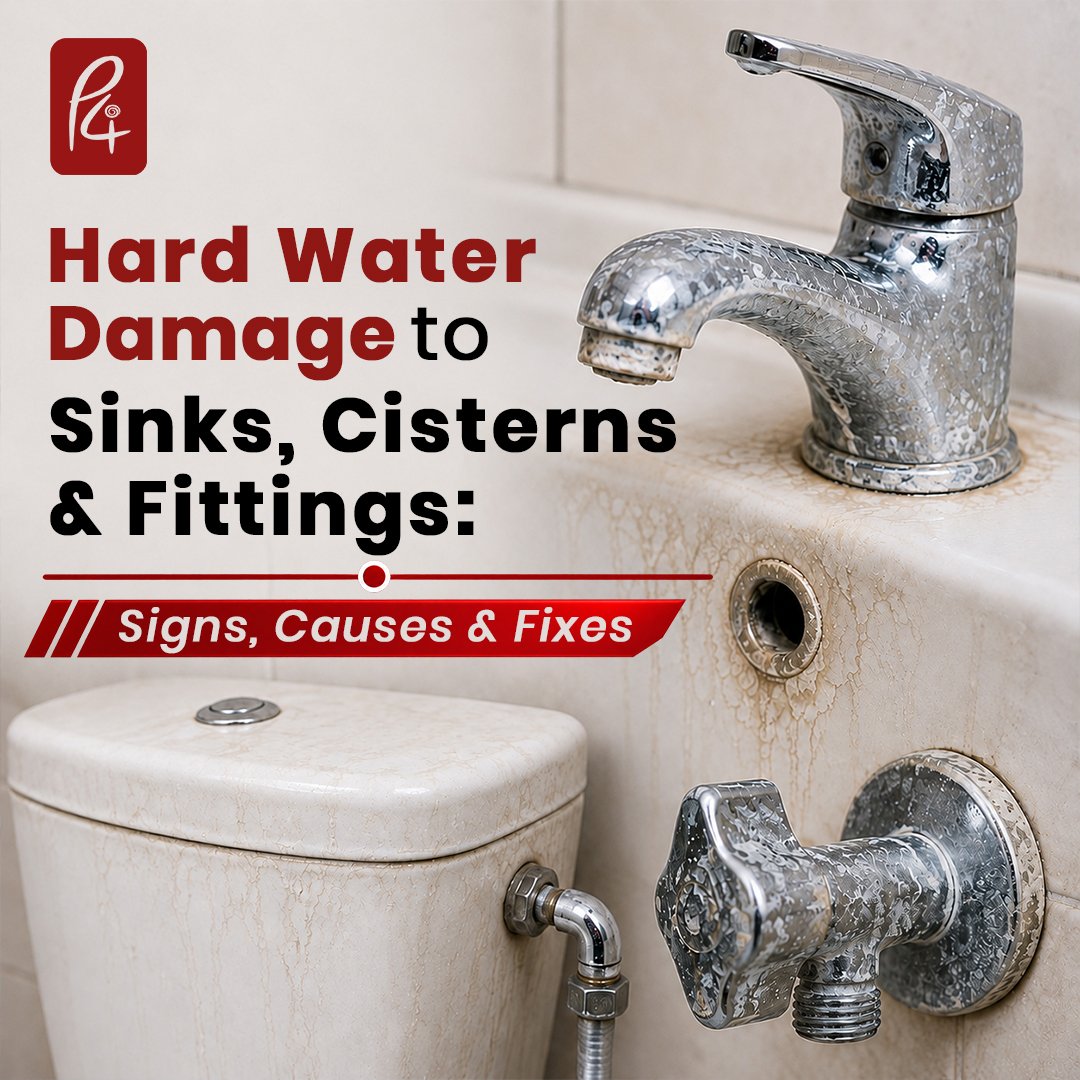
Visible limescale rings. The chalky ring at the cistern’s waterline is visible evidence of what’s simultaneously happening, invisibly, inside every moving part of the mechanism.
How Hard Water Damages CP Fittings and PTMT Taps
Chrome-plated (CP) fittings and PTMT fittings are especially exposed to hard water because they combine two vulnerabilities: constant water contact and moving mechanical parts.
- Tap handles and cartridges accumulate internal scale, causing stiffness, squeaking, or eventual seizure — a common reason taps become hard to turn within just a few years in hard-water areas
- Shower heads and health faucets develop blocked nozzles as limescale narrows outlet holes, reducing pressure and creating uneven spray patterns
- Mixer and diverter valves rely on precise internal tolerances that scale disrupts, leading to leaks, drips, or fittings that no longer switch cleanly
- External chrome surfaces lose their shine faster under repeated deposits, especially if hard water spots are left to dry rather than wiped down
Not all bathroom fittings in India are built to the same standard here — unbreakable PTMT fittings and properly sealed CP fittings hold up considerably longer under sustained mineral exposure than standard alternatives.
Why Hard Water Damage Gets Worse Over Time
Limescale doesn’t build up at a steady rate — it accelerates. A thin layer creates a rougher surface than bare metal or porcelain, and rougher surfaces trap minerals more easily than smooth ones. Each deposit builds faster than the last, which is why a fitting that seemed fine for years can deteriorate within months once scaling begins in earnest.
Heat makes it worse. Hot water holds more dissolved minerals than cold water can retain once it cools, which is why scaling is typically heaviest around geysers and hot water taps.
The True Cost of Ignoring Hard Water
| Factor | Untreated Hard Water Exposure | Managed / Protected Fittings |
| Typical fitting lifespan | 3–5 years before major issues | 8–12+ years |
| Cistern flush efficiency | Degrades steadily, often unnoticed | Maintained with periodic descaling |
| Sink surface condition | Permanent staining, dulling | Maintains finish with regular care |
| Replacement frequency | Every 3–4 years | Every 8+ years |
| Water wastage from valve issu | Cesontinuous trickle, higher bills | Minimal, caught early |
Households that never address hard water typically replace fittings, sanitaryware, and spare parts two to three times as often as those with a basic maintenance routine — a cost that compounds across every sink, cistern, and tap in the house, similar to the pattern in our piece on the real cost of a water leak.
Warning Signs You’re Already Dealing with Hard Water Damage
- A chalky white or grey ring around the cistern waterline or sink drain
- Taps noticeably stiffer to turn than a year ago
- Reduced pressure from showerheads or aerators with no reported supply issue
- A cistern that runs continuously or refills slowly
- Cloudy, spotted staining on stainless steel that won’t wipe away
- Soap that lathers poorly and leaves a filmy residue
If several of these apply, scale buildup is likely already affecting more than one fitting in your home — not just the one you’ve noticed.
What Actually Protects Sinks, Cisterns, and Fittings from Hard Water
Regular descaling. A vinegar-and-water soak or commercial descaling solution, applied every one to two months to aerators, showerheads, and cistern components, prevents buildup from compounding.
Choose fittings built for hard water conditions. Not all CP fittings and cisterns handle mineral exposure equally — better-grade chrome plating and properly sealed valve mechanisms resist scale adhesion far longer than budget alternatives. P4 India‘s CP Fittings and PTMT ranges are built specifically with India’s widespread hard water conditions in mind.
Wipe surfaces dry after use. Standing water that evaporates on a surface leaves its full mineral content behind; wiping dry after use meaningfully slows visible staining.
Consider a water softener for severely hard-water regions. A point-of-entry softener reduces scale formation across every fitting simultaneously, rather than treating each one individually.
Inspect cisterns and valves periodically, not just when a problem becomes obvious — catching early-stage scaling is far cheaper than replacing a seized valve or fully scaled float mechanism.
Frequently Asked Questions
How do I know if my area has hard water?
Signs include soap that doesn’t lather easily, white residue on utensils, and visible scaling around taps and cistern waterlines. Local water reports or a hardness test kit can confirm mineral content directly.
Can hard water damage be reversed once it’s happened?
Surface scaling can often be removed with descaling solutions, but internal damage to valve seals and cartridges is frequently permanent once components have seized or corroded — replacement is usually the more reliable fix.
Do more expensive fittings resist hard water better?
Generally, yes. Fittings with better-quality chrome plating, tighter valve tolerances, and properly sealed mechanisms — like IS 12701 certified CP fittings — resist scale adhesion and mechanical failure longer than budget alternatives, even under identical water conditions.
How often should I descale my cistern and taps?
For moderately hard water, every one to two months for taps and aerators, and a full cistern inspection roughly every six months. Severely hard-water areas need more frequent attention.
Is a water softener worth installing for a single household?
For homes with consistently hard water, a softener protects every fitting simultaneously and typically pays for itself in extended fitting lifespan and reduced maintenance.
Are P4 India‘s fittings and sanitaryware built for hard water areas?
Yes — P4 India‘s CP Fittings, PTMT range, and Sanitaryware are manufactured with corrosion- and
scale-resistant materials suited to India’s widespread hard water conditions, reducing the staining, seizing, and valve failures common in standard bathroom fittings.
Protect What’s Behind the Chrome
Hard water damage is one of the most preventable — and most ignored — sources of plumbing wear in Indian homes. Fittings that fail early usually aren’t poorly installed; they’re under constant, invisible mineral attack nobody addressed in time.
Explore P4 India‘s CP Fittings, PTMT, Sanitaryware, Cistern, and Kitchen Sink range — built to hold up against India’s hard water conditions.