
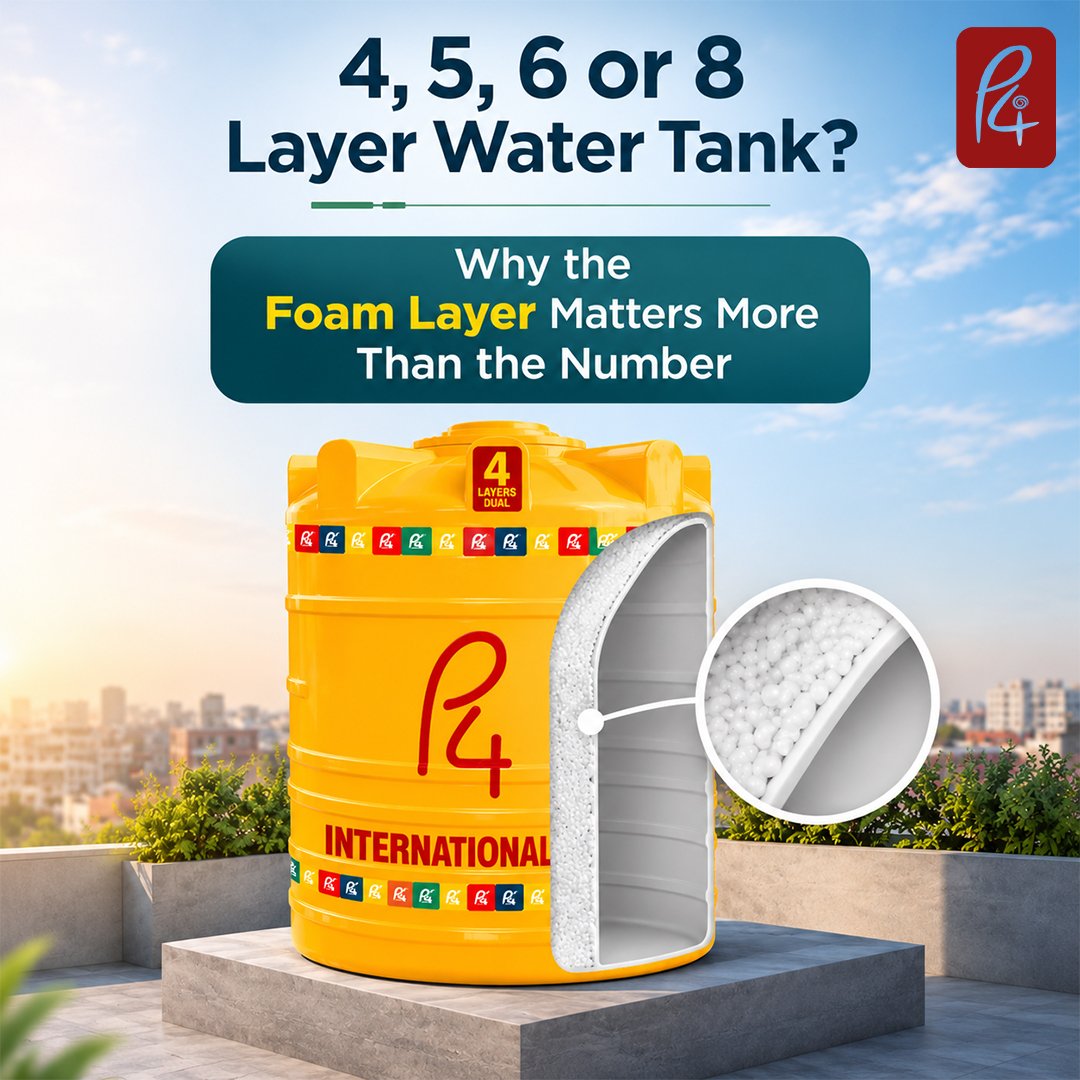
An 8 layer water tank isn’t automatically better than a 4 or 5 layer one. What keeps your water cool is the foam insulation layer (usually PUF, polyurethane foam), how thick it is, and whether the lid is insulated too. A 4-layer tank with a thick foam core can keep water cooler than an 8-layer tank whose extra layers are thin coats of plastic.
That’s the whole argument. The rest of this post explains why, and shows you how to check a tank before you buy.
The 2 pm tap test
You’ve probably done this. It’s a May afternoon. You open the bathroom tap and the “cold” water comes out hot enough to make you pull your hand back. Your tank has been on the roof since sunrise, soaking up heat through its walls and lid.
Now here’s the odd part. Plenty of people who get that hot water have a 5 or 6 layer tank. They paid for more layers because they were told more layers meant cooler water. So what went wrong?
Usually, nobody told them which of those layers was doing the cooling.
What each layer in a water tank actually does
Brands describe their layers differently, but most tanks are built from some mix of these:
| Layer | What it does | Does it keep water cool? |
|---|---|---|
| Outer colour or UV layer | Looks good, resists sun damage. Some reflect heat (P4 uses UV-16 and IRR infrared reflection) | A little, if it reflects heat |
| Black or dark UV-block layer | Stops light reaching the water, so algae can’t grow | No. Dark layers absorb heat |
| Foam insulation layer (PUF) | Traps heat in the wall so less reaches the water | Yes. This is the main one |
| Inner food grade layer | The only layer that touches your water; must be safe for drinking | No |
| Antimicrobial or special inner layer | Slows bacteria, or adds copper or silver | No |
Look at the last column. Out of five common layer types, one does the real work against heat. The rest protect against light, germs or wear. Those jobs matter too, but they don’t cool your water.
Why foam does the heavy lifting
This is plain physics, and it’s worth a minute.
Every material passes heat at a certain rate, called its thermal conductivity. Lower means it blocks heat better. Published values for polyethylene, the plastic used in water tanks, sit around 0.33 to 0.5 W/m·K. Rigid polyurethane foam sits around 0.020 to 0.025 W/m·K.
In other words, the same thickness of foam slows heat roughly 15 times better than solid tank plastic. Adding a sixth or seventh thin plastic layer to a tank barely changes how fast heat gets in. Adding foam, or making the foam thicker, changes it a lot.
That’s why “how many layers?” is the wrong first question. The right ones are: which layer is foam, and how thick is it?
How layer counts get inflated
There’s no single rule for counting layers. Some brands count the lid. Some count a coating as a layer. You’ll see labels like “9+1” because an extra jacket or skin is counted separately. None of this is dishonest exactly. But it means a bigger number on the box tells you very little.
A 6-layer tank built from six thin plastic layers and no foam will run hot on an open roof. A 4-layer tank with a thick foam core and an insulated lid won’t. Same rooftop, same sun, different water.
Don’t forget the lid
The lid takes the sun at the hottest angle, straight down at midday. A tank with insulated walls and a thin plastic lid has a hole in its insulation right where the heat is strongest.
This is why P4 puts insulation in the lid too. Most P4 tanks use D²LF: two foam-insulated lids, one airtight and one locking. P4 says the double lid also keeps mosquitoes out and holds firm in cyclones, which matters in coastal Bengal and Odisha. On the Cool G tank, P4 describes the 2-piece lid as designed for zero heat entry from the top.
Which layer water tank is best for home?
It depends on where the tank sits, not on the number.
| Where your tank is | What you need |
|---|---|
| Indoor loft or fully shaded spot | A good 2 or 3 layer food grade tank. Foam is a nice-to-have. |
| Covered terrace, partial sun | A tank with a foam layer. An insulated lid helps. |
| Open rooftop, summers above 40°C | Foam insulation plus an insulated lid. This is where foam earns its price. |
| Extreme heat, or the tank feeds kitchen and drinking water | Thicker foam, insulated double lid, and consider a thermal jacket |
For most homes in Kolkata, Delhi, Patna, Lucknow or Bhubaneswar, the tank is on an open roof. So for most readers the answer is a foam tank with an insulated lid, whatever the layer count.
P4 tanks, sorted by insulation
Here’s the P4 range described the way we think tanks should be described: by foam and lid first.
| P4 tank | Layers | Insulation and lid | Good for |
|---|---|---|---|
| Polyfoam ISI | 2 | No foam layer; black carbon inner layer; airtight lid. ISI to IS 12701 | Shaded spots, large sizes (up to 10,000 L), tight budgets |
| P4 Food Grade | 4 | 4-layer foam insulation, 6 mm walls, single-piece insulated lid | Rooftops on a mid-range budget |
| P4 International | 4 | Thick foam middle layers as a heat barrier, D²LF double foam lids, UV-16 and IRR outer layer | Open rooftops; 15-year warranty |
| P4 5 Layer PUF | 5 | PUF foam insulation, IRR, D²LF double lids, 20% extra storage | Buying online with delivery |
| Cool G | 5 | Foam-filled insulating layers, 8 mm walls, PUF-insulated 2-piece lid, non-black inner layer | Very hot roofs |
| P6 | 6 | PUF with high-pressure foaming (HPRF); P4 says heat protection up to 48°C with 50% heat reduction | Extreme heat |
| Silver Alkaline | 7 or 9+1 | 7-layer PUF heat shield body, or 9+1 with external skin jacket; D²LF lids | Premium buyers who want alkaline water |
Notice that the Polyfoam ISI is in there with no foam at all. We’re not hiding it. For a tank in a shaded spot, or a 10,000 litre tank for a building, it’s the sensible choice. The point is to pick on purpose.
Foam isn’t unique to P4, either. Supreme, Vectus and Sintex all have foam models. See how Sintex, Supreme and Vectus compare. The difference at P4 is that foam and insulated lids are standard across most of the range rather than reserved for one premium model.
5 questions to ask the dealer
- Which of these layers is foam? If the answer is vague, assume there isn’t one.
- Is the lid insulated, or just plastic?
- How thick is the wall? P4 publishes 6 mm for the Food Grade tank and 8 mm for Cool G. Compare like for like.
- Is the inner layer food grade, and can I see a certificate? Our food grade water tank guide covers what to look for.
- What does the warranty cover, and for how long?
FAQs
Is an 8 layer water tank better than a 4 layer tank?
Only if the extra layers include more or thicker foam. Layer count alone doesn’t decide how cool the water stays. A 4-layer tank with a thick foam core can outperform an 8-layer tank without one.
Which layer water tank is best for summer?
One with a PUF foam insulation layer and an insulated lid. For an open Indian rooftop, that matters far more than whether the tank has 5, 6 or 8 layers.
What is a PUF water tank?
A PUF tank has a layer of polyurethane foam inside its wall. The foam traps heat in the wall so less of it reaches the water, keeping water cooler in summer.
Does a foam tank keep water warm in winter?
It helps. Insulation slows heat moving in either direction, so the water changes temperature more slowly than in a non-insulated tank. It won’t heat cold water, though.
Is a 5 layer tank better than a 3 layer tank?
If the extra two layers include foam, yes, for a tank in the sun. If they’re just extra plastic or colour layers, the difference in water temperature will be small.
Pick a tank by its foam
Start with the P4 International water tank for an open rooftop, or the P6 6 Layer PUF tank if your summers are extreme. For very hot roofs, compare the Cool G 5 Layer tank. You can also buy the P4 5 Layer PUF tank online.