
Introduction
RO purifiers have become the default answer to India’s inconsistent water quality — and for good reason, since reverse osmosis is genuinely effective at removing dissolved contaminants, heavy metals, and excess salts. But that same filtration process has a side effect most households never think about: it strips out the natural minerals in water along with the contaminants, leaving behind water that’s clean but nutritionally empty and often mildly acidic.
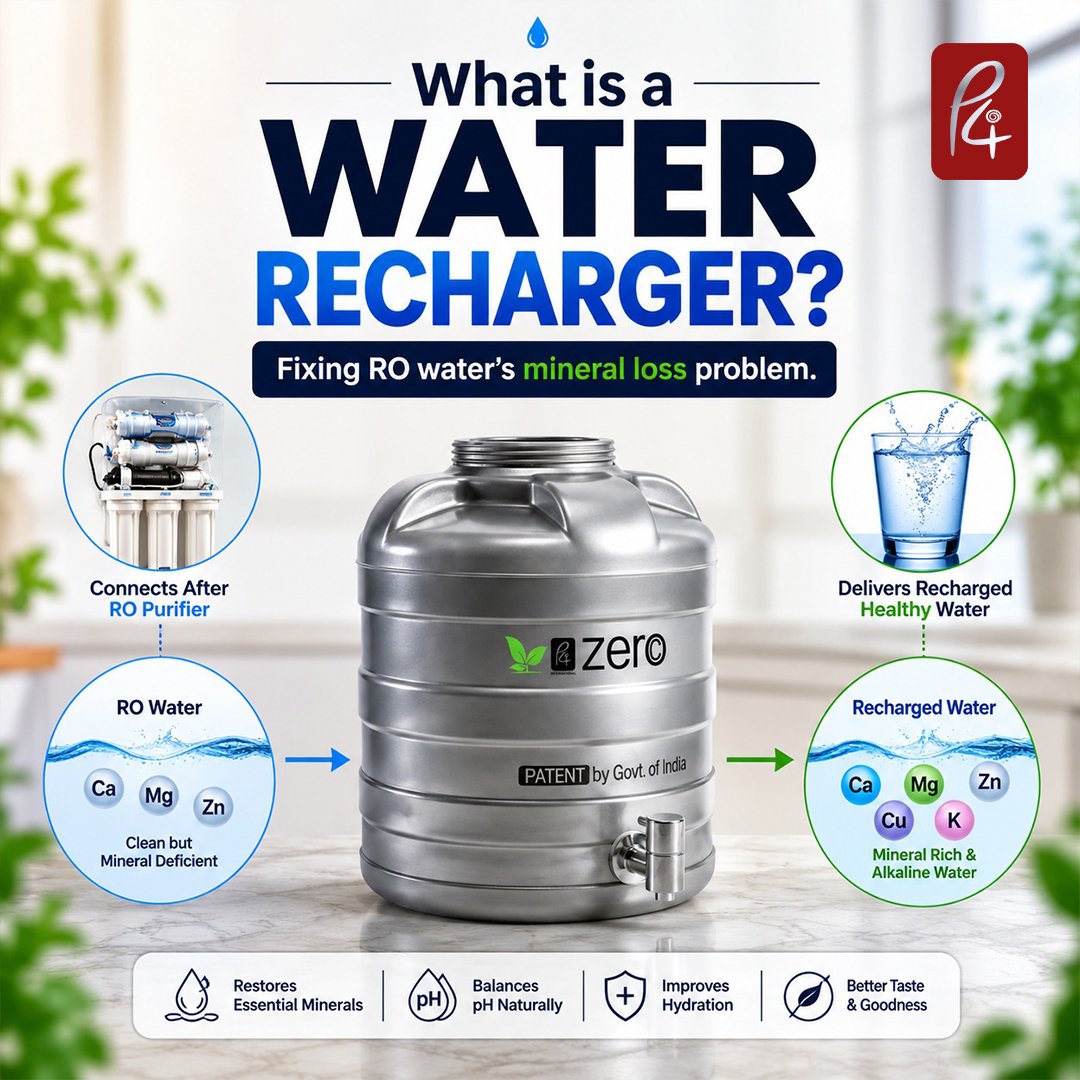
A water recharger is designed to solve exactly this problem. This guide from P4 India explains what happens to water during RO purification, what a water recharger actually does, and how a non-electric, mineral-enriching device like the P4 Zero C fits into a household’s existing RO setup — and why so many households run an RO system for years without realising this gap exists.
What RO Filtration Actually Removes From Your Water
Reverse osmosis works by forcing water through a semi-permeable membrane fine enough to block dissolved salts, heavy metals, bacteria, and most other contaminants. It’s a genuinely effective purification method — but the membrane doesn’t distinguish between harmful contaminants and beneficial dissolved minerals, since both pass through the same physical filtration barrier.
As a result, RO-purified water typically comes out significantly demineralized — calcium, magnesium, zinc, and other trace minerals that were naturally present in the source water are removed along with everything else.
Independent lab comparisons of demineralized versus mineral-enriched water show the difference clearly: demineralized water can show calcium levels below 0.5 mg/L and zinc below 0.0005 mg/L, compared to mineral-enriched water showing calcium around 6.4 mg/L and zinc around 1.13 mg/L in the same testing.
This demineralization is also part of why RO water often tastes noticeably “flat” or “empty” compared to natural spring or mineral water — much of what gives water its taste and body is exactly the mineral content RO removes in the purification process.
What Is a Water Recharger?
A water recharger is a container or in-line device that RO-purified water passes through (or is stored in) after filtration, designed to add essential minerals back into the water and typically raise its pH toward an alkaline range. Unlike RO systems, which rely on pressure and electricity to force water through a membrane, most water rechargers — including P4 India’s — work entirely without electricity, using mineral-infused internal components that interact with the water as it sits or flows through.
The core idea is straightforward: RO filtration removes minerals as a side effect of removing contaminants, and a water recharger restores some of that lost mineral content afterward, rather than trying to prevent the loss during filtration itself.
How the P4 Zero C Water Recharger Works
P4 India’s Zero-C Alkaline Recharger is built specifically to sit downstream of an RO system and address this demineralization gap. Its key design elements:
- Single-piece, seamless roto-moulded construction — no joints or seams where bacteria can accumulate, addressing a hygiene weak point common in multi-part containers
- Alkaline technology, patented by the Government of India — designed to raise the pH of RO-purified water naturally
- Mineral enrichment — restores calcium, magnesium, zinc, and copper to purified water, based on P4’s own lab comparison data showing meaningfully higher mineral levels after treatment
- Zero electricity required — works passively, with no power connection, unlike electric water ionisers that perform a similar alkalizing function
- 20L + 2L extra storage capacity — a 22-litre total capacity designed for household drinking water needs
- 99.9% germ-free design — supported by the seamless, joint-free construction that limits places for bacterial growth to take hold
This positions the Zero-C as a companion device to an existing RO system rather than a replacement for one
— it doesn’t purify water itself, it restores what purification removes.
Why Demineralized Water Matters for Everyday Health
It’s worth being precise about what mineral loss in drinking water actually means, since the topic gets both understated and overstated across the industry.
What’s well established: Long-term consumption of water with very low mineral content is associated with concerns in nutritional and public health literature, partly because water is one of several dietary sources of calcium, magnesium, and other trace minerals, and partly because demineralized water can be mildly acidic, which some people find affects taste and digestive comfort.
What’s more product-specific: P4 India’s own testing associates its alkaline recharger technology with benefits including antioxidant properties, pH enhancement, and mineral content aligned with IS-10500 (India’s drinking water quality standard). Broader claims sometimes associated with alkaline water — such as
anti-ageing or antiviral effects — are part of ongoing wellness discussion in this space rather than settled clinical consensus, so it’s worth treating those specific claims as the manufacturer’s positioning rather than
independently established medical fact.
The more grounded, verifiable point is simpler: RO water is measurably lower in essential minerals than source water, and a water recharger measurably restores some of that mineral content — which is a meaningful, practical benefit regardless of how the broader wellness claims are framed.
Water Recharger vs Electric Water Ionizer: What’s the Difference?
Households evaluating how to re-mineralize or alkalize RO water often come across electric ionizers as an alternative. The core differences:
| Factor | Water Recharger (Non-Electric) | Electric Water Ionizer |
| Power requirement | None | Requires continuous electricity |
| Installation complexity | Simple, passive setup | More complex, often plumbed in |
| Ongoing running cost | None | Electricity cost over time |
| Maintenance | Minimal, no electrical components to service | Electrodes and filters need periodic servicing |
| Mechanism | Mineral-infused container technology | Electrolysis to separate alkaline/acidic water streams |
| Best suited for | Households wanting a simple, low-maintenance water recharger | Households wanting customizable pH/alkaline levels and willing to invest in upfront cost and upkeep |
For most households already running an RO system, a non-electric water recharger like the Zero-C offers a simpler, lower-maintenance way to address the same demineralization problem an ionizer targets, without adding another electrical appliance or ongoing running cost to the kitchen.
Who Should Consider Adding a Water Recharger?
- Any household using an RO purifier as their primary water source, since demineralization is a near-universal side effect of RO filtration, regardless of the specific RO brand or system in use
- Households where RO water tastes noticeably flat compared to bottled mineral water or natural source water
- Families looking for alkaline water benefits without the electricity and maintenance requirements of an ionizer
- Anyone prioritising hygienic, low-maintenance storage for purified drinking water, given the seamless, joint-free construction that limits bacterial buildup compared to standard containers
- Households evaluating whether to add an expensive electric ionizer, since a non-electric recharger addresses much of the same mineral and pH gap at a fraction of the ongoing running cost
Common Misconceptions About Water Rechargers
“A water recharger purifies water.” It doesn’t — a water recharger works on already-purified water to restore minerals and adjust pH. It’s a complementary device to an RO system, not a substitute for one.
“More alkaline is always better.” Water pH matters, but extreme claims about alkaline water curing specific diseases go well beyond what’s established — treat alkaline technology as a genuine mineral and pH improvement, not a medical treatment.
“All water rechargers work the same way.” Build quality varies significantly — a seamless, single-piece construction like P4’s Zero-C avoids the joint-related bacterial growth risk that cheaper, multi-part containers
can introduce, which matters just as much for hygiene as any mineral-related design.
Frequently Asked Questions
Does a water recharger replace my RO purifier?
No. A water recharger works on water that’s already been purified by RO filtration — it doesn’t remove contaminants itself. It’s designed to sit after your RO system, restoring minerals that filtration removed.
How does a non-electric water recharger add minerals without any power?
Devices like P4 India’s Zero-C use mineral-infused internal materials that interact with water as it passes through or sits in the container, releasing trace minerals like calcium, magnesium, zinc, and copper without requiring electricity or moving parts.
Is RO water actually harmful without a recharger?
RO water is safe to drink, but its low mineral content and mildly acidic pH are genuine, measurable characteristics that some households choose to address, particularly for daily drinking water over the long term.
What’s the difference between P4’s Water Recharger and its Silver P4 International tank?
Both use alkaline technology, but they serve different roles — the Water Recharger (Zero-C) is a compact, 22-litre device designed to sit downstream of an RO system for daily drinking water, while Silver P4 International is a full-capacity household storage tank with its own alkaline and antimicrobial features built in.
Does the P4 Zero C need any maintenance?
Its single-piece, seamless construction and lack of electrical components mean minimal maintenance compared to an ionizer, though periodic cleaning is still recommended for any container used for daily drinking water.
Make Your Own Mineral Water at Home
RO purification solves one problem — contamination — while quietly creating another: mineral-depleted, often flat-tasting water. A water recharger closes that gap, restoring essential minerals and improving pH without adding electricity, complexity, or ongoing running costs to your kitchen.
Explore P4 India’s Water Recharger range, including the P4 Zero C Alkaline Recharger, to complete your RO water setup.
[CTA ® Water Recharger Product Range]