
Introduction
A dripping tap or a slightly loose pipe joint rarely feels urgent — easy to postpone, easy to forget, until a ceiling stains or a water bill doesn’t make sense.
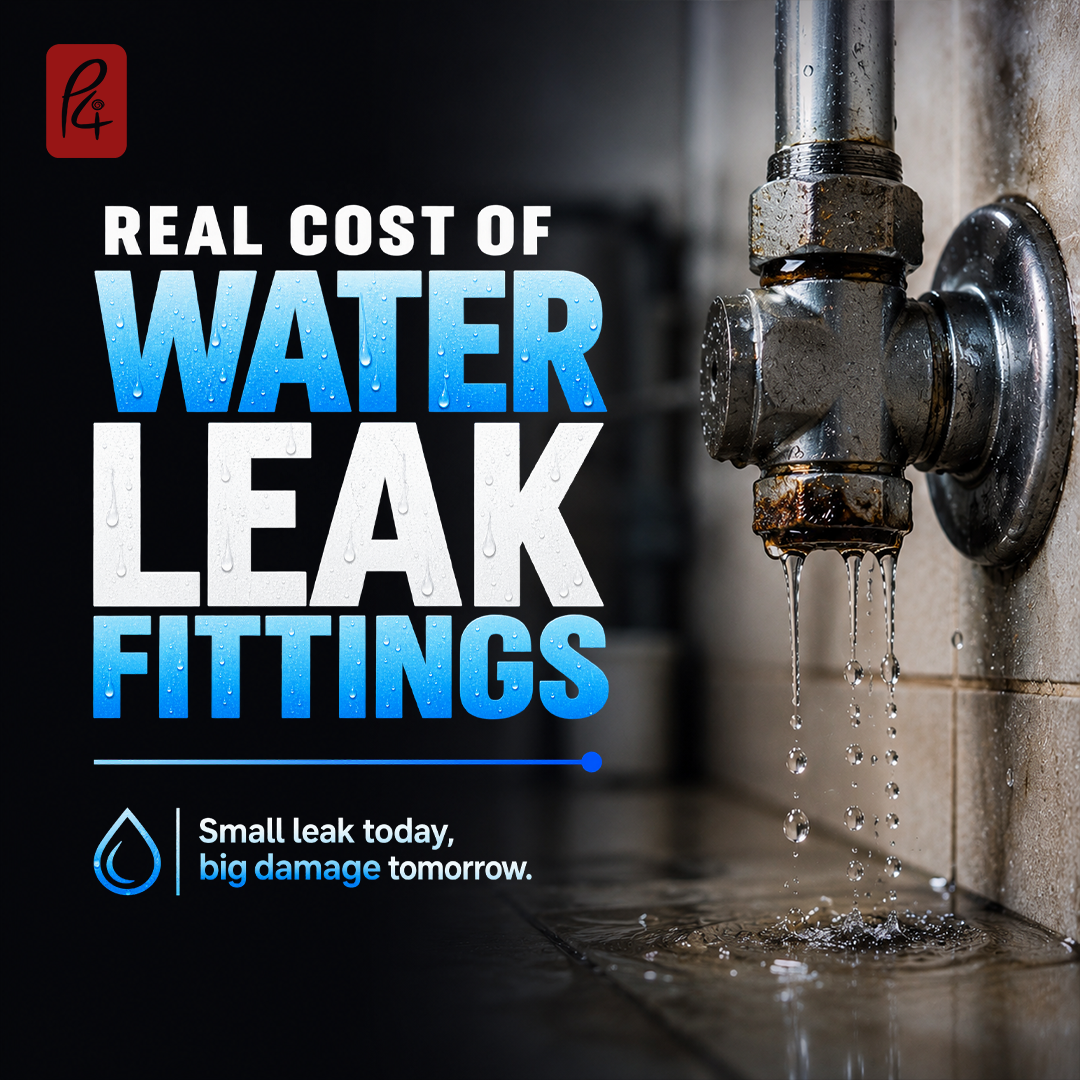
The damage from a leak is almost never proportional to its size. A worn-out washer or a corroded valve — among the smallest, least expensive parts in any home — can, left unaddressed, trigger repair bills running into lakhs once water reaches flooring, structural concrete, or electrical wiring. This guide from P4 India covers where household leaks start, what they cost when ignored, and why the cheapest insurance in plumbing is a fitting most people never think about until it fails.
Why Small Leaks Turn Into Big Problems
Water doesn’t stay where it starts. A leak at a joint or valve travels along the path of least resistance: down a wall cavity, along a floor slab, or through a construction joint into the flat below. By the time a stain appears, water has often been seeping unseen for weeks or months.
This is why real damage is rarely limited to the fitting itself. The cost multiplies as water spreads into materials that are expensive to fix: plaster, paint, flooring adhesive, electrical conduit, and in the worst cases, structural reinforcement.
The Most Common Points of Failure
Almost every household leak traces back to one of a handful of predictable failure points — which is also why almost every leak is preventable.
Washers and gaskets. The seals inside taps and valves degrade with age, heat, and constant water contact. A worn washer is one of the smallest, simplest fittings in the house, yet responsible for a disproportionate share of leaks.
Pipe joints and unions. Threaded joints, especially where dissimilar materials meet (copper to PVC, or old galvanised iron to newer fittings), are common leak points as sealant degrades or thermal expansion loosens the connection. Quality Pipes and correctly matched joint fittings reduce this risk.
Inlet and outlet valves. Cistern fill valves, angle cocks, and stop valves see constant use and mineral exposure, making them a frequent — and frequently ignored — source of slow leaks (see our piece on hard water damage for how scaling accelerates this).
Flexible connector hoses. The braided hoses connecting taps, geysers, and washing machines to the supply have a limited lifespan and are a common source of sudden, high-volume leaks.
Overflow pipes and tank fittings. A poorly sealed outlet on your water storage tank can leak continuously without being noticed, since the water often runs somewhere already expected to be wet, like a drain or external wall.
What a “Small” Leak Actually Costs Over Time
The maths on a slow leak is worse than most people assume. A dripping tap losing roughly one drop per second wastes over 11,000 litres of water a year — before any structural damage is even considered.
| Leak Scenario | Fix Required | Downstream Impact If Ignored |
| Worn tap washer | Simple washer swap, minutes of labour | Wasted water, eventual full valve replacement |
| Corroded angle cock | Straightforward valve replacement | Wall dampness, plaster damage, repeated repa |
| Failed flexible hose | Quick hose replacement | Sudden flooding, damaged flooring or furniture |
| Leaking pipe joint in wall | Localised repair, minor wall opening | Structural dampness, mould, extensive re-plast |
| Undetected slab leak | Professional leak detection | Flooring removal, slab repair, damage to a neig |
The pattern is consistent across every scenario: fixing the fitting early is quick and routine. The damage from ignoring it is not.
The Hidden Costs Beyond Repair Bills
Structural damage. Prolonged moisture weakens plaster, corrodes reinforcement steel, and can compromise structural integrity in severe cases.
Mould and health impact. Persistent dampness encourages mould, linked to respiratory irritation — relevant for households with children, elderly members, or anyone with asthma.
Damage to neighbours’ property. In apartments, an undetected leak often affects the flat below before it’s noticed in the source flat — turning maintenance into a legal and financial dispute.
Increased water bills. Even leaks too small to notice visually add up meaningfully over months.
Electrical hazards. Water reaching conduits or wiring embedded in walls creates a genuine safety risk, not just a repair inconvenience.
Warning Signs You Have an Active Leak
- A water bill that’s noticeably higher with no change in usage
- Damp patches, discolouration, or peeling paint on walls or ceilings
- A musty smell with no obvious moisture source
- The sound of running water when all taps are closed
- A water meter that keeps moving with no water in use anywhere in the house
- Unexplained mould growth near bathrooms, kitchens, or exterior walls
A simple check: turn off every tap and appliance, note your water meter reading, wait 30 minutes, then check again. Any movement indicates an active leak somewhere in the system.
Why Fitting Quality Is the Cheapest Insurance You Can Buy
Given how disproportionate the downstream cost is compared to the fitting that caused it, the case for
better-quality fittings is straightforward — exactly the gap P4 India’s CP Fittings, PTMT fittings, and Spare Parts ranges are built to close:
Better washers and cartridges last longer under pressure and heat cycling, reducing the single most common leak source in any home.
Corrosion-resistant valve bodies hold up better against hard water and mineral exposure than budget alternatives, reducing the angle cock and stop valve failures behind many slow, wall-hidden leaks.
Properly sealed CP fittings resist the internal scaling and seal degradation that eventually cause drips. P4 India’s unbreakable PTMT range is built specifically for India’s hard water and daily-use conditions.
Quality flexible connector hoses, rated for consistent pressure and periodically inspected, sharply reduce the risk of sudden, high-volume failures.
The price difference between a budget fitting and a quality, IS 12701 certified fitting is modest. Over 10–15 years, that difference is often the gap between routine maintenance and a major, disruptive repair.
A Practical Leak-Prevention Checklist
- Inspect visible fittings every few months — tap bases, valve connections, and flexible hoses under sinks and appliances
- Replace washers and cartridges proactively, rather than waiting for a visible drip
- Check your water meter periodically for movement during a no-usage window
- Address hard water buildup on valves and fittings before it accelerates seal degradation
- Upgrade ageing flexible hoses every 5–7 years, even without visible wear
- Don’t ignore a “minor” drip — treat it as an early warning, not a cosmetic annoyance
Frequently Asked Questions
How much water does a dripping tap actually waste?
A tap dripping roughly once per second wastes over 11,000 litres a year — enough to fill several household tanks, in water that’s simply paid for and lost.
How can I tell if a leak is happening inside a wall or under the floor?
Warning signs include damp patches, a musty smell with no obvious source, and a water meter that keeps moving when no taps are in use. A professional leak detection service can pinpoint the location without extensive demolition.
Is it worth replacing fittings before they actually fail?
For fittings older than 8–10 years, or any showing stiffness, staining, or reduced flow, proactive replacement with quality CP or PTMT fittings is almost always cheaper than the damage from a sudden failure.
Does homeowner’s insurance typically cover water damage from a leak?
Coverage varies by policy in India, and many policies distinguish between sudden accidental damage and damage from a leak left unaddressed over time. Check your specific policy terms.
What’s the single most important fitting to check regularly?
Flexible connector hoses to geysers and washing machines deserve particular attention, since their failure tends to be sudden and high-volume rather than gradual.
Are P4 India’s fittings and spare parts suitable for hard water areas?
Yes — P4 India’s CP Fittings and PTMT range use corrosion-resistant, scale-resistant materials suited to India’s widespread hard water conditions, reducing the valve and cartridge failures that cause many household leaks.
Don’t Wait for the Ceiling Stain
The gap between a small worn-out fitting and a major repair bill isn’t really about bad luck — it’s almost always a small warning sign left unaddressed for months or years. Regular inspection and quality fittings are the cheapest protection available for any Indian home.
Explore P4 India’s CP Fittings, PTMT fittings, Pipes, and Spare Parts range — built to reduce the leaks that cause the real damage.