
Introduction
Steel water tanks have a long history in India — stainless steel, in particular, carries a reputation for strength and durability that many households still trust by default. But strength on paper doesn’t always translate into the best choice for storing drinking water over years of daily use, especially against India’s climate, water quality, and installation conditions.
Silver P4 International, P4 India’s alkaline-technology water tank, represents a very different engineering approach — multi-layer LLDPE construction instead of metal. This guide compares the two head-to-head across the factors that actually matter for a household: hygiene, corrosion, durability, weight, temperature control, and long-term cost — so you can decide which tank material genuinely suits your home, rather than defaulting to whichever material feels more familiar.
Steel Tanks: The Traditional Choice, and Its Real Limitations
Steel tanks — whether mild steel, galvanised, or stainless steel — have been used in Indian households and commercial buildings for decades, largely because metal is intuitively associated with strength. But steel tanks come with a set of well-documented drawbacks that matter specifically for water storage:
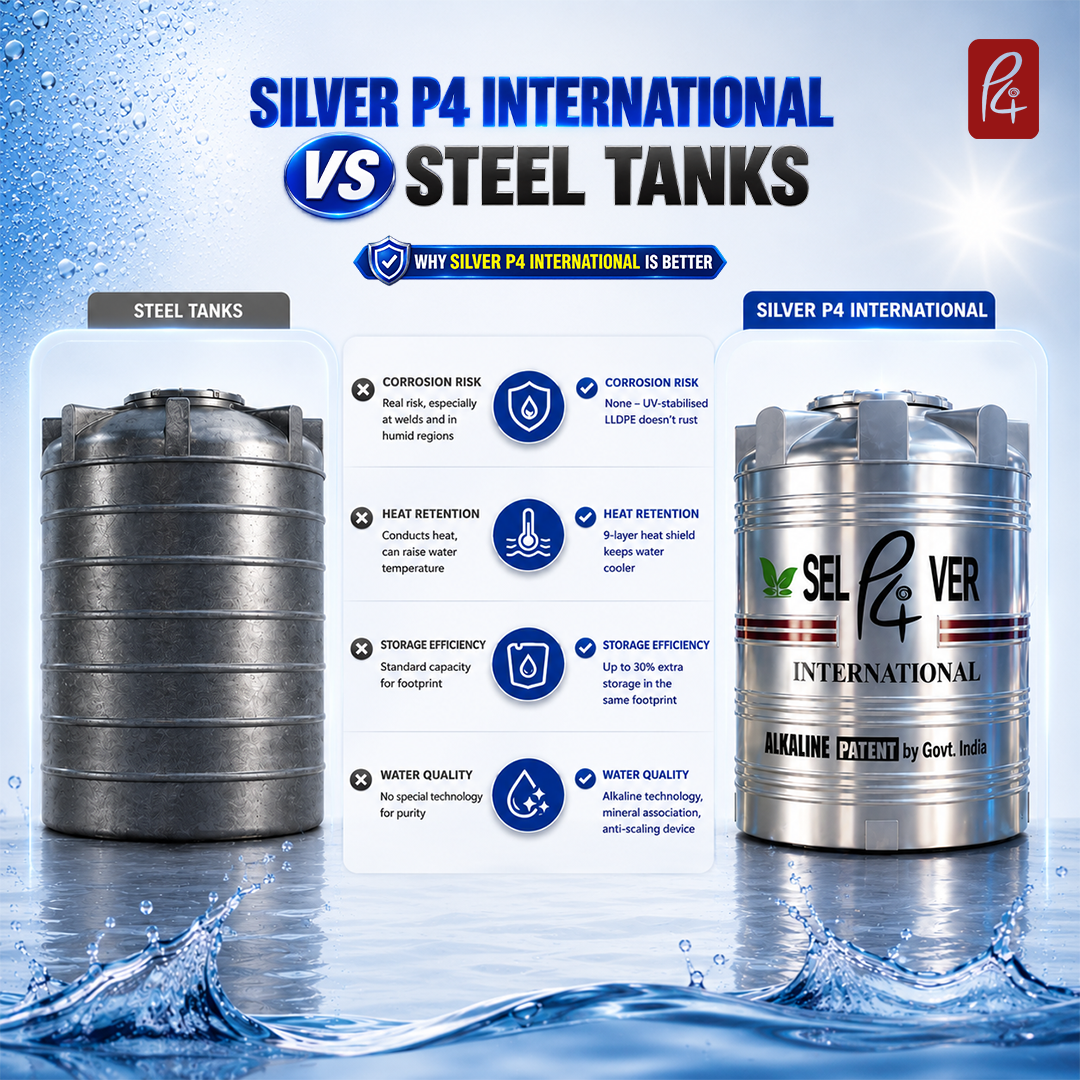
Corrosion and rust. Even stainless steel isn’t fully immune to corrosion, particularly at welded joints, in humid coastal regions, or where water quality is aggressive. Mild steel and galvanised tanks rust far more readily, and once rust begins, it contaminates stored water directly rather than staying contained, often before it becomes visible from outside the tank.
Heavier installation requirements. Steel tanks are significantly heavier than plastic alternatives of the same capacity, requiring stronger rooftop or platform support, additional labour for lifting and positioning, and often professional installation crews rather than a straightforward DIY-assisted setup.
Heat conduction. Metal conducts heat far more efficiently than plastic, meaning steel tanks placed on an exposed rooftop in Indian summers can heat stored water considerably more than an insulated tank — an issue for anything used for drinking or cooking, and one that gets worse the longer water sits between refills.
Higher long-term maintenance. Welded seams need periodic inspection for corrosion, and any coating or lining used to protect the metal interior can degrade over time, requiring reapplication or repair — an ongoing cost that plastic tanks largely avoid.
Cost of correction. Once a steel tank begins rusting or a weld starts failing, repair options are limited — patch welding or full replacement are usually the only paths forward, unlike plastic tanks where certain issues can be addressed more simply, and where there’s no ferrous metal to corrode in the first place.
What Silver P4 International Is Built From Instead
Silver P4 International uses UV-stabilised LLDPE (linear low-density polyethylene) — the same base material used across P4 India’s tank range — engineered into a multi-layer, food-grade construction rather than a single-layer metal shell. Its specific feature set addresses many of the exact weak points steel tanks struggle with:
- 9-layer heat shield body — multi-layer insulation and an outer jacket designed to keep stored water cooler, addressing the heat-conduction problem steel tanks face directly
- 99.91% germ-free water — a food-grade inner layer designed for safe household use, without the corrosion-related contamination risk that affects ageing steel tanks
- 30% extra storage space — engineered to store up to 1,300 litres in what would be a standard 1,000-litre footprint, a space efficiency metal tanks don’t typically offer
- Dual-Lid D2LF Safety — airtight, locking lids that protect against dust, insects, and storm damage, a sealing approach suited to plastic construction
- Naturally alkaline water technology — raises water pH without electricity, chemicals, or added machinery
- Free anti-scaling device and Jacket-P4 — included accessories aimed at softening hard water and protecting against heat, bundled with the tank itself
No rust is possible with LLDPE construction, since there’s no ferrous metal to corrode in the first place — a structural advantage rather than a maintenance workaround.
Where Steel Tanks Still Have an Edge
To be fair to steel as a category, it isn’t without genuine advantages in specific situations:
- Very large industrial or commercial installations sometimes favour steel or steel-reinforced concrete for structural reasons at scale beyond typical household capacities
- Fire-adjacent installations where extreme heat resistance is a specific requirement steel handles differently than plastic
- Established local fabrication — in some regions, steel tank fabrication and repair services are more locally available than access to certified plastic tank dealers, though this gap has narrowed considerably as brands like P4 India expand distribution
For the vast majority of residential and most commercial water storage needs in India, though, these scenarios are the exception rather than the rule.
Why Material Choice Matters More Than People Realise
A water tank isn’t a passive container — its material directly affects what happens to the water inside it over months of storage. Steel’s corrosion risk isn’t a rare edge case; it’s a predictable outcome of using ferrous metal in constant contact with water, humidity, and, in many Indian regions, hard or mineral-rich water that accelerates the process. LLDPE tanks like Silver P4 International sidestep this entire failure category structurally, rather than trying to manage it through coatings or maintenance schedules that need constant upkeep.
This is also why food-grade certification matters more with plastic tanks than it might initially seem — not all plastic is equal, and a properly certified, multi-layer LLDPE tank behaves very differently from a thin, uncertified plastic container that degrades and leaches under sun exposure. If you’re evaluating tank options more broadly, our best water tank buying guide covers what certification and construction details are worth checking regardless of material, and our piece on copper tank benefits looks at how a different premium technology tier compares on similar terms.
Who Should Choose Silver P4 International Over a Steel Tank
- Households in humid, coastal, or high-rainfall regions where steel corrosion risk is highest
- Anyone prioritising lighter installation without the structural reinforcement steel tanks often require
- Households interested in alkaline drinking water and mineral association without adding a separate treatment system
- Homes in hot climates where heat-conducting steel tanks noticeably warm stored water
- Buyers who want a longer warranty period and simpler long-term maintenance than steel’s weld-and-coating upkeep
Frequently Asked Questions
Do steel water tanks actually rust from the inside?
Yes — even coated or galvanised steel tanks can develop internal corrosion over time, particularly at welded seams or where the protective coating wears thin. Stainless steel resists this better but isn’t fully immune, especially with hard or mineral-rich water.
Is a plastic tank like Silver P4 International as durable as steel?
Multi-layer, UV-stabilised LLDPE tanks are engineered specifically for structural durability and long-term water exposure — Silver P4 International carries a 15-year warranty, which is comparable to or longer than many steel tank warranties, without the corrosion risk steel carries.
Does a steel tank affect water taste or quality?
It can, particularly as corrosion begins — trace rust or metallic taste can develop in ageing steel tanks. Food-grade, IS 12701 certified plastic tanks are designed to avoid affecting water taste or quality over the tank’s lifespan.
Is Silver P4 International heavier or lighter than a similar-capacity steel tank?
Significantly lighter. LLDPE tanks are considerably lighter than steel tanks of equivalent capacity, simplifying installation and reducing the structural support required on rooftops or platforms.
What capacities does Silver P4 International come in?
Silver P4 International is available in 500, 750, 1,000, 2,000, and 5,000 litre capacities, with the tank’s design allowing up to 30% extra effective storage compared to a standard tank of the same footprint.
The Material Decision Is the Foundation Decision
Choosing between a steel tank and a modern LLDPE tank isn’t just a cosmetic or price decision — it determines how your stored water behaves for the next decade or more. Silver P4 International addresses the structural weaknesses steel tanks are known for, while adding alkaline water technology, extra storage efficiency, and a long warranty on top of a corrosion-free foundation.
Explore Silver P4 International and see how P4 India’s alkaline tank technology compares to traditional steel water tanks.
[CTA ® Silver P4 International Product Page]