
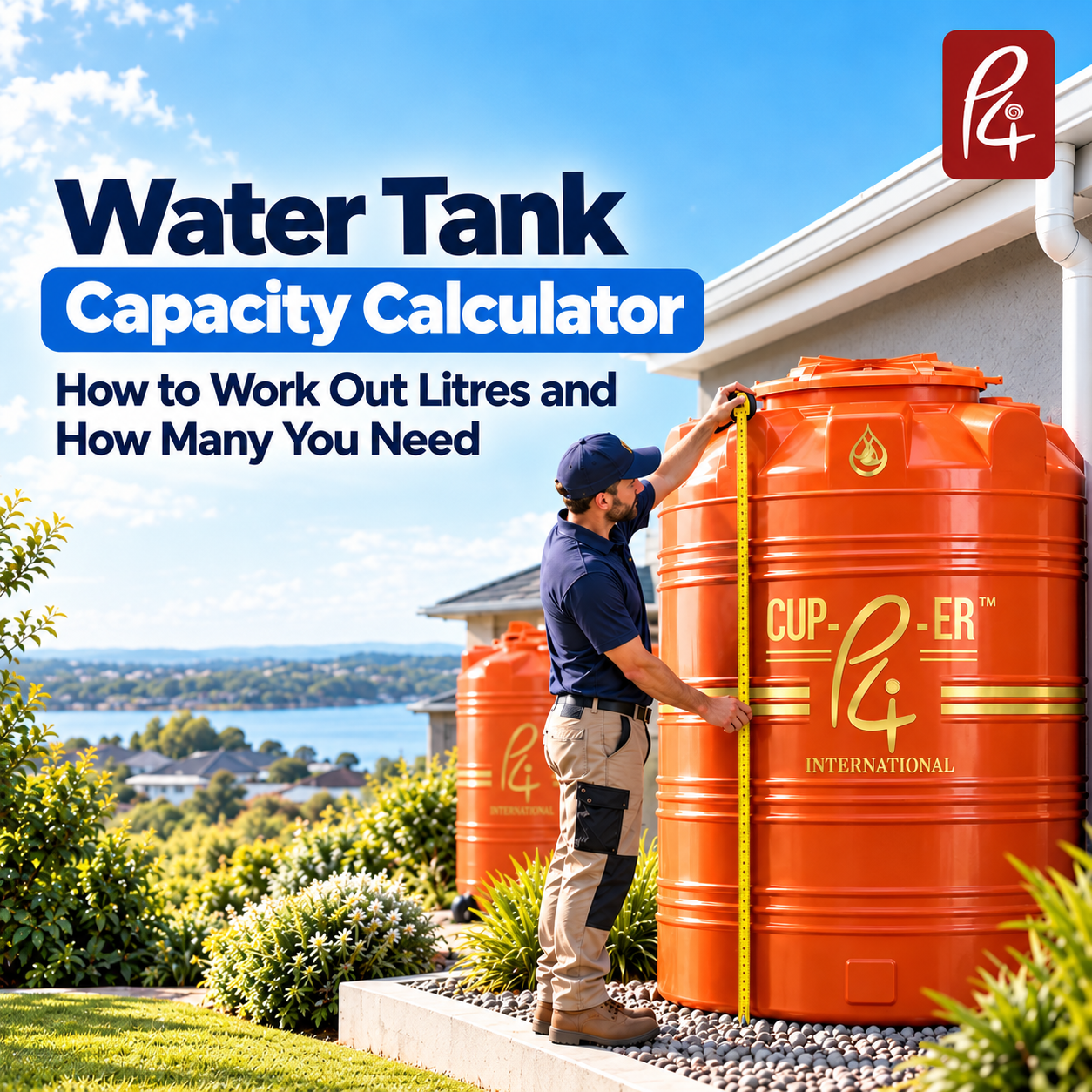
To find a rectangular tank’s capacity, multiply length × width × height in metres to get cubic metres, then multiply by 1,000 for litres. In feet, multiply the cubic feet by 28.3 for litres. For a round tank, use 3.14 × radius × radius × height. A family of four needs about 540 litres a day, so a 1,000 L tank covers a little under two days.
How to Calculate Capacity of a Rectangular Tank
Measure the inside of the tank, not the outside. Wall thickness takes a few centimetres off every side, and that adds up. Then use these steps.
- Measure the internal length, width and water height.
- Multiply the three numbers to get the volume.
- If you measured in metres, multiply the result by 1,000 to get litres.
- If you measured in feet, multiply the result by 28.3 to get litres.
| Tank size | Volume | Capacity in litres |
|---|---|---|
| 3 ft × 3 ft × 3 ft | 27 cubic feet | about 765 L |
| 5 ft × 5 ft × 4 ft | 100 cubic feet | about 2,832 L |
| 8 ft × 8 ft × 8 ft | 512 cubic feet | about 14,500 L |
| 1.5 m × 1 m × 1 m | 1.5 cubic metres | 1,500 L |
So an 8×8×8 ft tank holds about 14,500 litres, and a 5×5×4 ft tank holds about 2,830 litres. Those are the two sizes people search for most.
For an L-shaped or stepped tank, split it into two rectangles, calculate each one, then add the results. Do the same for a tank with an irregular base.
How to Calculate Capacity of a Round Tank
Most overhead tanks are cylinders. The formula is 3.14 × radius × radius × height, where the radius is half the diameter. Use metres and multiply by 1,000 for litres.
| Diameter | Water height | Capacity in litres |
|---|---|---|
| 0.9 m | 1.2 m | about 763 L |
| 1.0 m | 1.3 m | about 1,021 L |
| 1.2 m | 1.0 m | about 1,131 L |
Take the 1.0 m tank. The radius is 0.5 m, so 3.14 × 0.5 × 0.5 × 1.3 = 1.02 cubic metres, which is about 1,020 litres.
Many round tanks have a domed or sloping top. Measure only the straight section up to the water line, and ignore the dome, since the water never reaches it.
Why Real Capacity Is Lower Than the Maths
The formula gives the volume of the whole shape. In practice the water stops below the lid. The overflow pipe and float valve sit near the top, so the usable volume is a little less than the geometric one. Use the manufacturer’s labelled capacity for buying decisions, and use your own measurements only to check that a tank will fit.
Check the label against the listing, too. P4’s shop describes some of its lines with extra storage in the same footprint: 20% extra on the 5-layer PUF International tank, and 30% extra on the copper and silver models. Plan around the labelled capacity, then ask your dealer what the tank actually holds.
How Many Litres Does Your Family Need?
Planners in India commonly work with about 135 litres per person per day for household use. Multiply that by the number of people, then decide how many days of buffer you want.
| People | Daily need | Suggested tank | Days it covers |
|---|---|---|---|
| 2 | 270 L | 500 L | about 1.9 days |
| 3 | 405 L | 750 L | about 1.9 days |
| 4 | 540 L | 1,000 L | about 1.9 days |
| 5 | 675 L | 1,000 L | about 1.5 days |
| 6 | 810 L | 2,000 L | about 2.5 days |
| 8 | 1,080 L | 2,000 L | about 1.9 days |
If your supply is reliable and arrives daily, one day of buffer is enough and you can go smaller. If it fails often, add days. Our 1000 litre water tank price guide shows what that size costs.
Quick Conversions
- 1 cubic metre = 1,000 litres
- 1 cubic foot = 28.3 litres
- 1 litre = 1,000 cubic centimetres
- 1 imperial gallon = 4.55 litres, and 1 US gallon = 3.79 litres
Which Size for Which Situation
- A couple in a flat with daily supply: 500 L is enough.
- A family of four: 750 L if supply arrives daily, 1,000 L if it’s irregular.
- A joint family of eight or more: 2,000 L, or two 1,000 L tanks so you can drain and clean one at a time.
- A home with a long dry season: go one size up, because summer bathing, cooling and cleaning push use above the average.
Overhead Tank, Underground Tank or Both
Many homes use both. The underground tank (sump) stores more and the overhead tank feeds the taps by gravity. A common approach is to size the overhead tank for about one day and let the sump hold the larger reserve, but ask your plumber to confirm for your building. P4 says its tanks suit both outdoor and underground use.
Sizing for an Apartment Building
The same maths scales up. Take 20 flats with 4 people each: that’s 80 people, and 80 × 135 = 10,800 litres a day. P4 says it makes tanks from 100 L to 10,000 L and customises sizes, so a building like this could use two 5,000 L tanks plus a smaller buffer, or a custom size. Compare options in our guide on which water tank is best for your home.
Check the Weight Before You Install
One litre of water weighs one kilogram. A full 1,000 L tank carries about 1,000 kg of water plus the weight of the tank, and a 2,000 L tank carries about two tonnes. Put it on a level, load-bearing platform, and ask a structural engineer to check the roof for large tanks.
Will It Fit? Check the Footprint
Capacity isn’t the only number that matters. A round tank 1.2 m across needs a base of about 1.13 square metres (3.14 × 0.6 × 0.6). Leave about 30 cm all round so someone can reach in and clean it, which means a platform of roughly 1.8 m by 1.8 m. Measure the space, the door and the stairs before you order.
Mistakes to Avoid
- Measuring the outside of the tank instead of the inside
- Treating the geometric volume as the usable capacity
- Buying a tank so big the water sits for days before it’s used
- Forgetting the roof can’t take the full weight
Water Tank Capacity: FAQs
How many litres is an 8×8×8 water tank?
About 14,500 litres. It’s 512 cubic feet, and one cubic foot is 28.3 litres.
How many litres is a 5×5×4 water tank?
About 2,830 litres. It’s 100 cubic feet.
How do I convert cubic feet to litres?
Multiply by 28.3. For cubic metres, multiply by 1,000.
Is a 1,000 litre tank enough for a family of four?
Yes, in most cases. A family of four uses about 540 litres a day, so 1,000 litres covers a little under two days.
Is a 500 litre tank enough for two people?
Yes. Two people use about 270 litres a day, so 500 litres covers close to two days.
How do I find the capacity of a tank I already own?
Measure the inside and use the formulas above. For a more exact figure, empty the tank and refill it with a 20 litre bucket, counting each bucket, or read your water meter before and after filling.
Should I buy by the label or by my own measurements?
Buy by the manufacturer’s labelled capacity. Use your own measurements to check that the tank fits its space.
Browse the P4 tanks range from 100 L up to 10,000 L and get a quote from your nearest dealer.