
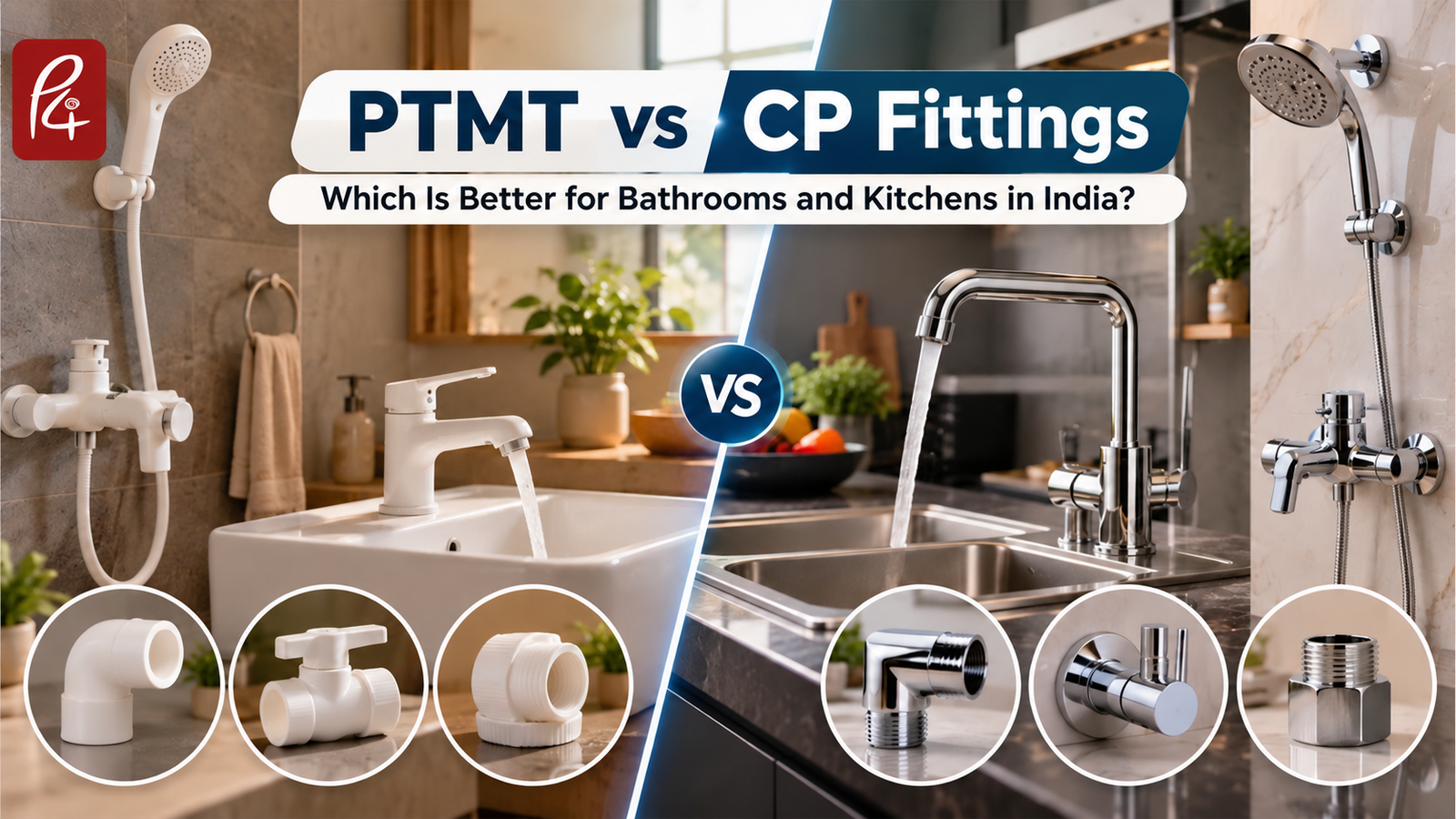
Pick PTMT for utility taps, damp bathrooms, hard-water homes and tighter budgets, because it doesn’t rust. Pick CP (chrome-plated brass) for the fittings people see and handle every day, such as basin mixers and showers, where finish and weight matter. Many homes use both.
What PTMT and CP Mean
PTMT stands for poly tetramethylene terephthalate, a tough engineering plastic that’s also sold as PBT. CP stands for chrome plated: a brass body finished with a nickel-chrome coating that gives taps their shine.
That one difference, plastic against plated metal, drives almost everything below.
PTMT vs CP Fittings Side by Side
| Factor | PTMT | CP (chrome-plated brass) |
|---|---|---|
| Rust and corrosion | Doesn’t rust or pit | Brass resists rust; thin plating can wear or flake |
| Hard water | Doesn’t corrode, though scale can still deposit | Plating can pit over time in harsh water, depending on quality |
| Strength | Tough and light; can crack if over-tightened or hit hard | Heavier and stronger under force |
| Look and feel | Plastic finish, fewer premium looks | Bright metallic finish, solid weight |
| Hot water | Check the maker’s temperature rating | Commonly used on hot lines |
| Price | Lower | Higher |
| Best for | Bib cocks, angle cocks, health faucets, utility use | Basin and shower mixers, visible fittings |
Brass taps were the default for decades. PTMT fittings became common in Indian homes as a lighter, rust-free alternative at a lower price, and most brands now sell both.
Where PTMT Makes Sense
Bathrooms in humid cities like Kolkata are hard on metal. Steam, damp air and soapy splashes sit on fittings all day. PTMT doesn’t care about moisture, so it suits the taps you rarely look at but use constantly: the P4 PTMT bib cock, angle cocks and health faucets.
Rented homes and secondary bathrooms are another good fit. You get a tap that lasts without paying for a finish nobody will inspect. Browse the P4 unbreakable PTMT range to see the options.
Where CP Makes Sense
A basin mixer or shower is part of the room’s look. CP gives the bright finish and heavier feel people expect in those spots, and brass is a standard choice for hot-water lines.
The catch is plating quality. Thin plating can bubble or pit within a couple of years. Look closely at the finish, ask what the warranty covers and buy from a maker that stands behind the plating. See the P4 CP fittings range.
The Tap Names, Explained
- Pillar cock: a tap that stands on a basin or kitchen platform, with the water entering from below. Try the P4 PTMT pillar cock.
- Bib cock: a wall-mounted tap with a bent nose, common in bathrooms for filling buckets.
- Angle cock: a small valve fitted at a right angle on the supply line, used to isolate a basin, cistern or geyser.
- Health faucet: a handheld spray for hygiene, normally fitted beside the toilet.
- Stop cock: a valve that shuts off a section of pipework. P4 sells a concealed stop cock for in-wall fitting.
Which Material Where: Room by Room
| Fitting | Suggested material | Why |
|---|---|---|
| Wash basin mixer | CP | Visible, and carries hot and cold supply |
| Shower and wall mixer | CP | Handled daily, sits on the hot line |
| Bib cock | PTMT | Always wet, and rarely looked at |
| Health faucet | PTMT | Constant moisture and splashes |
| Angle cocks | PTMT | Hidden, and damp all the time |
| Kitchen sink cock | Either | CP for a matching look, PTMT for budget and hard water |
| Washing-machine and balcony taps | PTMT | Damp or outdoor, and no finish needed |
Treat this table as a starting point. Check the rated temperature and pressure in the product’s specifications before you fit any tap on a hot line.
A Practical Mix for One Bathroom
For a typical bathroom, use CP for the wall mixer and shower. Those are the visible fittings, and they sit on the hot line. Use PTMT for the bib cock, health faucet and angle cocks, where you want long life at a lower cost.
You get the finish where it shows and the corrosion resistance where moisture does the damage. It’s also easier on the budget than going all brass.
Hard Water and Your Taps
Hard water leaves white scale around spouts, aerators and handles, and it happens on both materials. On CP, scale combined with abrasive scrubbing wears the plating. On PTMT, harsh cleaners can dull the surface. Wipe both with a soft cloth and a mild cleaner, and unscrew the aerator now and then to clear the build-up.
Looking After Each Type
- CP: wipe dry after use, and skip bleach and scouring powder.
- PTMT: wash with mild soap and water, and don’t over-tighten when fitting.
- Both: replace a worn washer or cartridge as soon as a drip starts.
- Both: keep acidic descalers off the surface, or rinse them off quickly.
Signs a Fitting Is Poor Quality
- Visible pits, bubbles or an uneven shine on the finish
- Rough moulding seams or leftover flash on plastic parts
- A handle that wobbles, or a spindle that feels gritty
- No brand name, batch detail or marking on the body
How to Think About Cost
A cheap tap that fails in two years costs more than a mid-priced one that lasts ten. Add the plumber’s visit and the wall you may have to open, and replacement gets expensive fast. Spend where failure hurts most (concealed parts and hot lines) and save where it doesn’t (utility taps).
Renovating a Bathroom: Where to Start
Start with the pieces behind the wall, because they’re the hardest to change later. Choose the concealed stop cock and the angle cocks first. Then pick the visible fittings (mixer, shower, basin tap) to match your tiles and sanitaryware. Leave the utility taps for last, since they’re cheap to swap and don’t affect the look.
What to Check Before You Buy
- Standards marking. Look for the ISI mark where it applies, and ask the dealer which standard covers the exact model.
- Cartridge. Ceramic disc cartridges generally outlast rubber washers.
- Weight and finish. Pick the tap up. A CP tap that feels hollow-light deserves questions, and so does any finish with visible pits or uneven shine.
- Warranty. Ask what it covers, and whether it covers the finish.
PTMT vs CP Fittings: FAQs
Which is better for hard water?
PTMT doesn’t corrode, so it holds up well against mineral-rich water, though scale still collects on its surface. Well-plated CP also copes if you clean it regularly.
Should I use PTMT in the kitchen?
For the sink cock, either works. Choose PTMT for budget and hard water, or CP for a matching look with other fittings.
What is the full form of PTMT?
Poly tetramethylene terephthalate, an engineering plastic also known as PBT.
Is PTMT better than brass?
Neither wins everywhere. PTMT wins on rust resistance and cost. Brass wins on strength and finish.
Do PTMT taps break easily?
Good-quality PTMT is tough. Taps usually crack when they’re over-tightened or hit hard, so tighten to the manufacturer’s guidance.
Can PTMT fittings be used for hot water?
Check the maker’s rated temperature on the product or in its specifications before using it on a hot line.
Can I mix PTMT and CP in the same bathroom?
Yes. Mixing is common, and the two work together without any problem. Only the finish differs, so keep colours consistent where fittings sit side by side.
When should a tap be replaced?
There’s no fixed interval. Replace a tap when it leaks even after a new washer or cartridge, or when the finish has started to fail.
Does P4 make both PTMT and CP fittings?
Yes. P4’s shop lists both an Unbreakable PTMT range and a CP Fittings range. See the P4 unbreakable PTMT range and the P4 CP fittings range, or explore the Almino range.
Choose your fittings from the P4 PTMT and CP ranges, and find a dealer near you.