
Introduction
Rooftop overhead tanks endure conditions few other household products face: direct, unfiltered sun for most of the year, extreme temperature swings, and constant structural load from standing water. A well-built tank handles this for a decade or more. A cheap one often doesn’t make it past year four or five — and the failure is rarely as simple as “it just wore out.”
Here’s what’s actually happening inside a low-grade plastic overhead tank, and why the savings on day one rarely hold up over its real lifespan.
Why Overhead Tanks Face Harsher Conditions Than Any Other Plastic Product in Your Home
Nothing else in a typical household sits in direct rooftop sun, holds hundreds of kilograms of water continuously, and is expected to last 10+ years without maintenance. This combination — constant UV exposure, thermal cycling (hot days, cooler nights), and sustained structural load — is uniquely demanding, and it’s exactly where material quality differences show up fastest.
A tank made from virgin, UV-stabilised polymer is engineered specifically to withstand this. A tank made from recycled or blended lower-grade plastic, cutting costs to compete on price, simply wasn’t built for it — and the difference becomes visible within a few years, not decades.
The Real Disadvantages of Cheap Plastic Tanks
1. UV Degradation and Brittleness Low-grade plastic lacks proper UV stabilisers, so constant sun exposure causes the outer surface to become chalky, brittle, and prone to micro-cracking. Once cracking starts, it accelerates — each crack lets in more UV-accelerated stress on the surrounding material.
2. Chemical Leaching Recycled or substandard polymer can leach chemicals — including compounds like BPA in poorly regulated material — into stored water, especially as heat accelerates the breakdown of the plastic structure. This happens continuously, not as a one-time event, meaning exposure compounds daily over the tank’s life.
3. Microplastic Shedding As the inner surface degrades, it doesn’t just release chemicals — it sheds physical microplastic particles into water used for drinking, cooking, and bathing. This is a direct, daily-contact source of microplastic exposure that most households don’t realise is happening.
4. Structural Failure Under Load A 1000-litre tank holds roughly 1,000 kg of water. Cheap tanks with thinner walls or inconsistent material distribution are more prone to bulging, splitting, or sudden failure under this sustained load — sometimes without warning, and often at the worst possible time (mid-summer, when demand is highest).
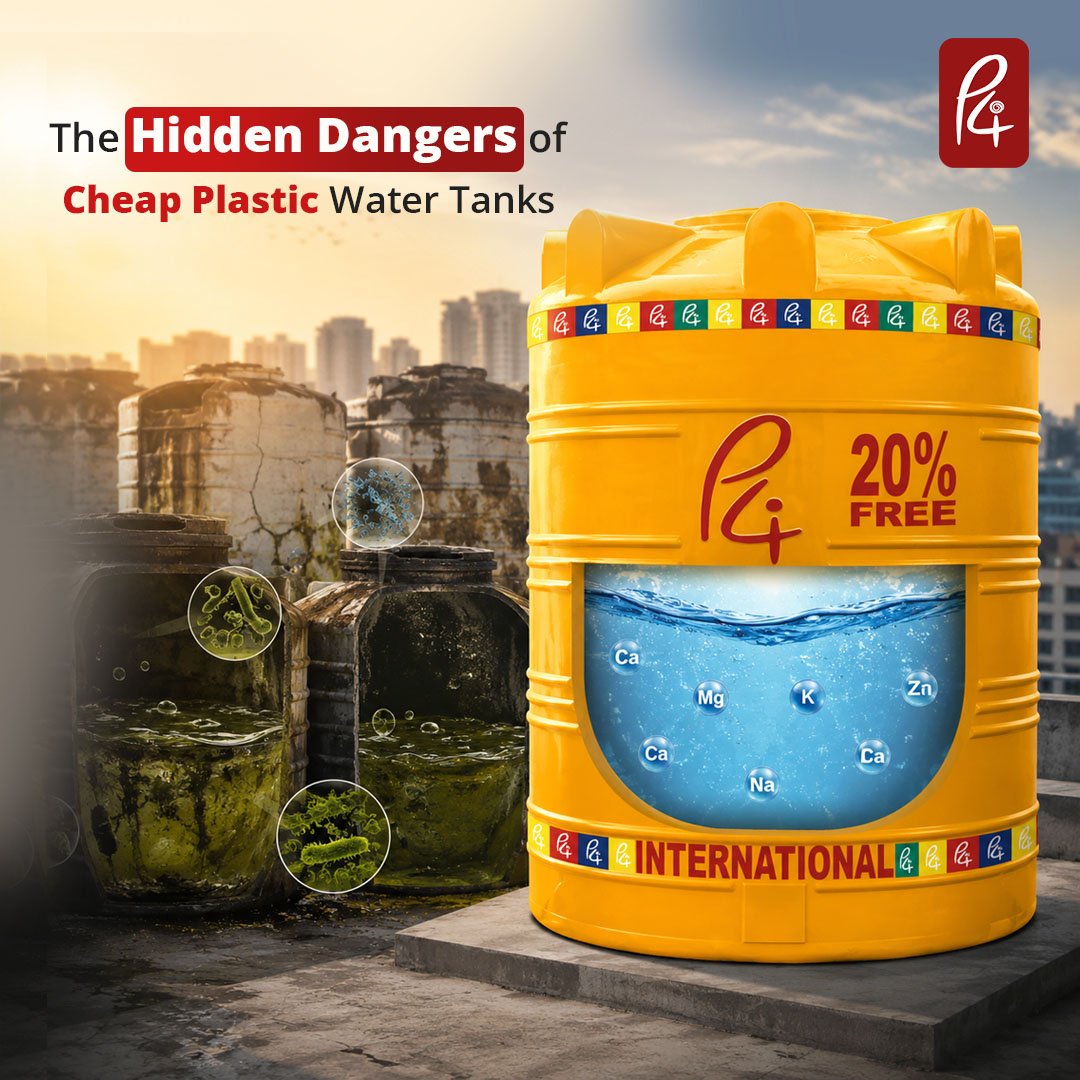
5. Poor Heat Insulation Low-grade plastic insulates poorly, allowing stored water to heat up significantly during the day. Warm, stagnant water is an ideal environment for bacterial and algae growth — one reason cheap-tank water often develops odour or taste issues faster than expected.
6. Faster Algae Growth Budget tanks frequently skip the light-blocking middle layer used in proper multilayer construction, allowing light to penetrate and encourage algae growth on the inner walls — a problem that compounds through monsoon and summer alike.
7. Short Real-World Lifespan Despite marketed lifespans of 10-15 years, cheap tanks commonly fail within 3-5 years of real rooftop use — meaning the “savings” of a lower purchase price are erased, and then some, by an early replacement cycle.
Why Overhead Tanks Specifically Fail Faster Than Underground Tanks
Underground or sump tanks face far gentler conditions — shielded from direct sun, more stable temperatures, and no wind-load stress. Overhead tanks face the full brunt of the conditions above, which is exactly why material quality matters disproportionately more for rooftop installations than for underground storage.
If a household is going to economise anywhere, an underground tank is generally more forgiving of a mid-range material choice. An overhead tank is not — it’s the worst possible place to compromise on plastic grade, precisely because it’s under the most sustained stress.
The True Cost of “Cheap”: A Realistic Comparison
| Factor | Cheap Plastic Tank | Certified Multilayer Tank |
|---|---|---|
| Typical real-world lifespan | 3–5 years | 10–15 years |
| UV stabilisation | Minimal or none | Built into outer layer |
| Algae resistance | Poor (often no light-blocking layer) | Strong (proper middle layer) |
| Chemical leaching risk | Higher, especially under heat | Minimised with food-grade material |
| Replacement cost over 15 years | 3–4 tank purchases | 1–2 tank purchases |
| Structural failure risk | Elevated, especially at full capacity | Low, engineered for sustained load |
Once you account for two or three replacement cycles, the “budget” tank is very often the more expensive choice over its real lifetime — before even factoring in the health-related costs of chemical exposure or contaminated water.
Warning Signs Your Overhead Tank Is Already Failing
- Chalky, faded, or brittle patches on the outer surface
- Visible cracking, especially near the lid, base, or outlet
- A green tint or slimy texture on inner walls when inspected
- Unusual taste or odour in tap water, especially after hot days
- Bulging or shape distortion, particularly when the tank is at full capacity
- Frequent need to “top up” due to slow, unexplained water loss (a sign of a developing leak)
If you notice any of these, don’t wait for a full failure — inspect and plan for replacement before the tank fails during peak summer demand, when it’s hardest to manage without one.
What to Look for When Choosing a Replacement
Ask for the polymer grade. Virgin material significantly outperforms recycled or blended plastic for rooftop durability.
Confirm IS 12701 certification directly, not just a general quality sticker — this specifically covers wall thickness, UV resistance, and structural standards relevant to overhead use.
Check for genuine multilayer construction, including a light-blocking middle layer, not just a single-layer tank marketed as “premium.”
Consider food grade or copper/silver variants if the tank is specifically for drinking water, given the added protection against leaching and microbial growth.
Don’t buy based on price alone. Given how much harsher overhead conditions are, this is the one household plastic product where the cheapest option is almost never the best value over its real lifespan.
Frequently Asked Questions
How long should a good overhead water tank actually last? A properly certified, UV-stabilised multilayer tank should last 10–15 years with minimal degradation under normal rooftop conditions.
Why do cheap tanks specifically fail on rooftops rather than elsewhere? Overhead installations face constant direct UV exposure, temperature swings, and sustained structural load from standing water — conditions that expose material weaknesses far faster than gentler underground storage.
Is it worth paying more for a food grade overhead tank? Yes, particularly if the tank supplies drinking and cooking water — food grade material specifically reduces chemical leaching and microplastic shedding risk that intensifies with heat exposure on rooftops.
Can a cracked tank be repaired instead of replaced? Minor surface issues can sometimes be temporarily managed, but once cracking begins, it’s typically a sign of broader material degradation — repair is rarely a lasting fix, and replacement is the safer long-term choice.
What’s the biggest single mistake people make when buying an overhead tank? Choosing based on lowest upfront price without checking polymer grade or certification — exactly the factors that determine whether the tank survives its harsh rooftop environment for the intended lifespan.
Choose for the Conditions, Not Just the Price Tag
An overhead tank has one of the toughest jobs of any plastic product in your home — and it’s precisely where cutting corners on material quality shows up fastest and most expensively. Before your next purchase, look past the price tag and check what the tank is actually made of.
Explore P4 International’s certified, multilayer overhead tank range — built for India’s rooftop conditions. [CTA → Product range]