
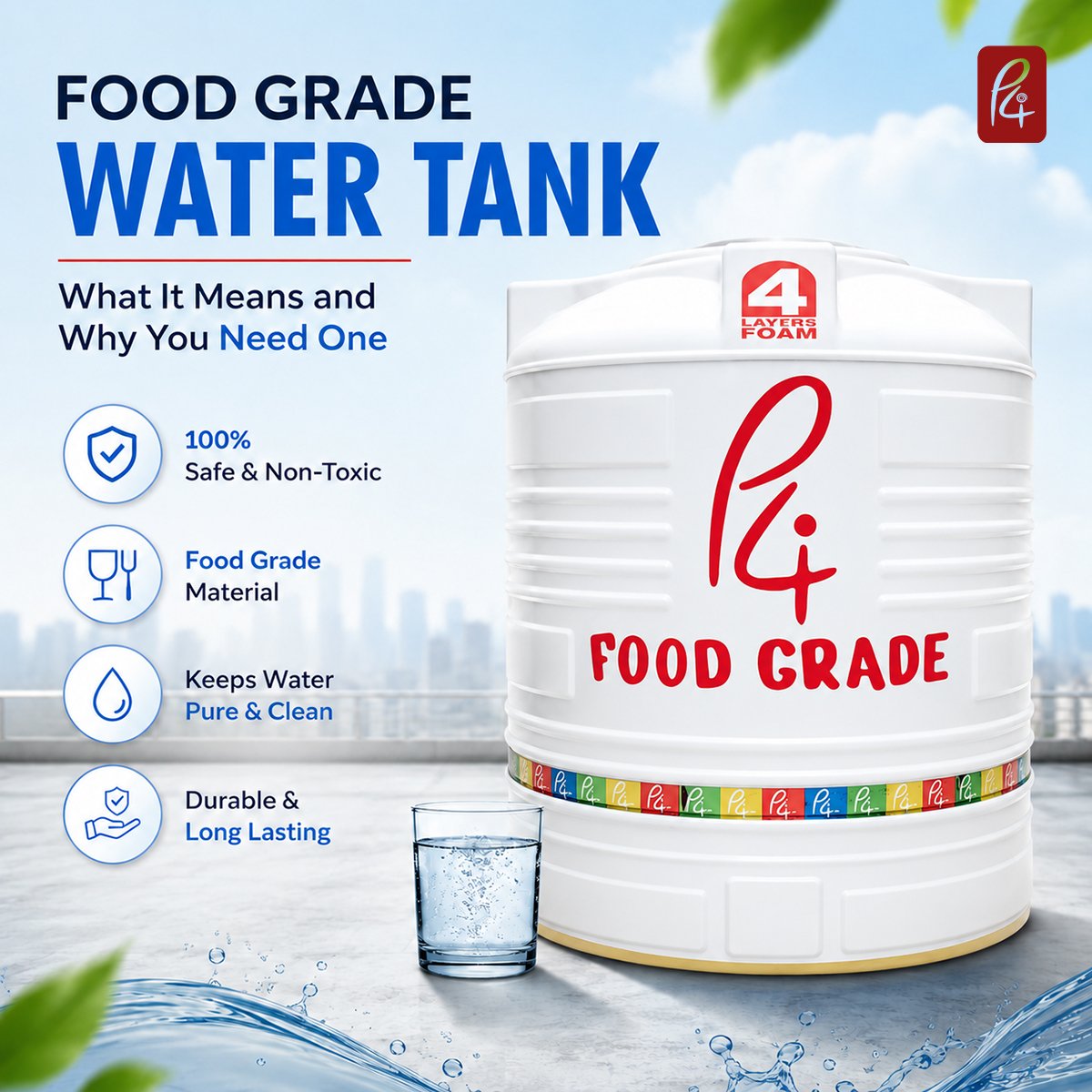
Introduction
Walk into any plumbing supply shop in India and you will see tanks labelled “food grade” alongside standard tanks — often at a higher price. Most buyers assume “food grade” simply means “safe for drinking water” and wonder whether the premium is really necessary.
The reality is more nuanced, and more important. This article explains exactly what food grade means in the context of water storage tanks, what the IS 12701 certification actually requires, why it matters for your family, and how to verify you are genuinely buying a food-grade tank and not just a standard tank with a marketing label.
What Does “Food Grade” Mean for a Water Tank?
The term “food grade” describes materials that are safe for prolonged contact with food and drinking water — meaning they do not leach harmful chemicals, heavy metals or toxins into the water they hold.
For a water storage tank, food grade means three specific things:
1. Virgin LLDPE resin only All quality water tanks are made from LLDPE (Linear Low-Density Polyethylene). However, not all LLDPE is equal. Standard tanks may be manufactured using reprocessed or recycled LLDPE, which can contain trace contaminants from its previous use. A genuine food-grade tank uses only virgin (unused) LLDPE resin — no recycled content whatsoever.
2. Food-contact-approved additives only LLDPE requires stabilisers and colourants to be added during manufacture. In a standard tank, these additives only need to meet general safety standards. In a food-grade tank, every additive — including UV stabilisers, processing aids and pigments — must be approved for direct food and water contact.
3. Contamination-free manufacturing The manufacturing environment and equipment for food-grade tanks must ensure no cross-contamination from non-food-grade materials during production.
IS 12701 — India’s National Standard for Water Storage Tanks
The Bureau of Indian Standards’ IS 12701 certification is the mandatory quality standard for polyethylene water storage tanks in India. Its full title is: “IS 12701: Specification for Rotational Moulded Polyethylene Water Storage Tanks.”
IS 12701 covers:
- Minimum wall thickness at every point of the tank
- Structural performance under load (hydrostatic pressure testing)
- UV stabilisation requirements
- Chemical safety — specifically, that materials must meet food-contact safety standards
All reputable water tanks — standard, food-grade and copper — should carry the ISI mark confirming IS 12701 compliance. The IS 12701 standard itself already requires food-contact-safe materials.
So what is the difference between a “standard” ISI-certified tank and a “food-grade” ISI-certified tank?
The difference lies in the grade of resin and the strictness of the manufacturing process. A food-grade certified tank uses premium virgin resin specifically selected and tested for food contact, and is manufactured under stricter quality controls. Think of it as the difference between an ingredient that passes a minimum safety threshold and one that is specifically selected and tested for food service use.
Why Food-Grade Matters: The Health Case
India’s municipal water supply, while treated at source, travels through ageing distribution infrastructure before reaching your home. By the time water reaches your overhead tank, it has been in contact with pipes, joints and fittings of varying quality and age. The quality of your storage tank is the last line of defence before water reaches your family’s taps.
The Risk from Standard-Grade Materials
Polyethylene itself is generally inert and safe. The risk in non-food-grade tanks comes from:
- Recycled resin — reprocessed LLDPE can contain micro-contaminants from previous uses that are difficult to fully eliminate
- Non-approved additives — some UV stabilisers and pigments that are acceptable in non-food applications can leach trace amounts of compounds into stored water, particularly in high-temperature conditions (a rooftop tank in an Indian summer can reach 60°C+)
- Plasticisers — some are used in non-food-grade plastics as processing aids and are not appropriate for drinking water contact
Over a 15–20 year lifespan, the cumulative effect of prolonged exposure to even trace leachates in water used for drinking and cooking is worth taking seriously, particularly for households with children or pregnant women.
IS 12701 and the BPA Question
You may have seen “BPA-free” claims on water tanks and bottles. BPA (Bisphenol A) is a chemical used in polycarbonate plastics — not in LLDPE water tanks, which are BPA-free by nature of their material. For LLDPE tanks, the relevant question is not BPA but the virgin resin and additive quality described above.
P4 India Food Grade Water Tank — What Makes It Different
P4 India’s food-grade tank range is built to exceed the IS 12701 baseline:
- 100% virgin LLDPE resin — no recycled content in any layer
- Food-contact-approved additives only — every UV stabiliser, pigment and processing aid is selected for food-contact suitability
- Triple-layer construction — outer UV-resistant black layer, insulating foam middle layer, white food-grade inner layer
- ISI certified under IS 12701 — independently verified
- Dedicated food-grade production run — manufactured separately from standard tank production to prevent cross-contamination
P4 India’s food-grade tanks are available in capacities from 200L to 5,000L, covering home, commercial and institutional applications.
How to Verify You Are Actually Buying a Food-Grade Tank
Food grade is a selling point, which means some sellers apply the label loosely. Here is how to verify before you buy:
- Ask for the ISI certification number — genuine tanks have the IS 12701 licence number printed on the tank body, not just on packaging
- Check for virgin resin specification — a genuine food-grade tank’s product documentation will explicitly state “virgin LLDPE” or “100% virgin resin”
- Buy from an authorised dealer — counterfeits and mislabelled tanks are more common through unverified channels
- Check the BIS website — you can verify a manufacturer’s IS 12701 licence at bis.gov.in
Food Grade vs Standard vs Copper: Which Should You Choose?
| Standard Triple-Layer | Food Grade | Copper-Lined | |
|---|---|---|---|
| Virgin resin only | Not always | Yes — always | Yes — always |
| Food-contact-approved additives | IS 12701 baseline | Premium grade | Premium grade |
| Antimicrobial action | No | No | Yes — copper surface |
| Best for | General home use | Health-conscious families, young children | Maximum hygiene + health benefits |
| Price vs standard | — | ~15–25% more | ~30–50% more |
For the vast majority of Indian households, a food-grade tank is the right minimum standard. The price premium is typically only ₹500–₹1,000 more than a standard triple-layer tank of the same capacity — and the peace of mind it provides over 20 years of family water consumption is well worth it.
Frequently Asked Questions
Q: Is a food grade water tank necessary? A: For households where the tank water is used for drinking and cooking, a food-grade tank is strongly recommended. The price premium is small; the benefit is clean, chemically-safe water for your family over decades of use.
Q: What is IS 12701? A: IS 12701 is the Bureau of Indian Standards certification for polyethylene water storage tanks. It covers structural performance, UV stabilisation, wall thickness and food-contact material safety. Always buy a tank that carries the ISI mark confirming IS 12701 compliance.
Q: Are all ISI-certified tanks food grade? A: IS 12701 requires food-contact-safe materials as a minimum. A tank labelled specifically “food grade” uses premium virgin resin and stricter additive controls beyond the IS 12701 baseline. When in doubt, ask for the specific resin grade specification.
Q: Is a food grade tank better than a copper tank? A: Both are better than a standard triple-layer tank for drinking water use. The food-grade tank ensures premium-purity water-contact materials; the copper tank adds natural antimicrobial action on top of food-grade construction. For maximum water quality, the copper tank is the top tier. Learn more about copper water tanks.
Q: What capacity food grade tanks does P4 India offer? A: P4 India’s food-grade tanks are available from 200 litres to 5,000 litres. View the full food-grade range.
Shop P4 India Food Grade Water Tanks
P4 India’s food-grade water tanks are manufactured by BALAJI Rotomoulders Pvt. Ltd., ISI certified under IS 12701, and available across India through authorised dealers. Shop the food-grade range or find your nearest dealer.
Also in this series:
- Best Water Tank in India 2026 — Complete Buying Guide
- 1000 Litre Water Tank Price in India 2026
- Copper Water Tank Benefits — Why P4 India’s Copper Tank Is Worth It
P4 India food-grade water tanks are manufactured by BALAJI Rotomoulders Pvt. Ltd. and carry ISI certification under IS 12701.
Internal links to add on publish:
- “Learn more about copper water tanks” → /blog/copper-water-tank-benefits/
- “View the full food-grade range” → /water-tanks/ (or /water-tanks/food-grade/)
- “find your nearest dealer” → /contact/
- All “also in this series” links as noted